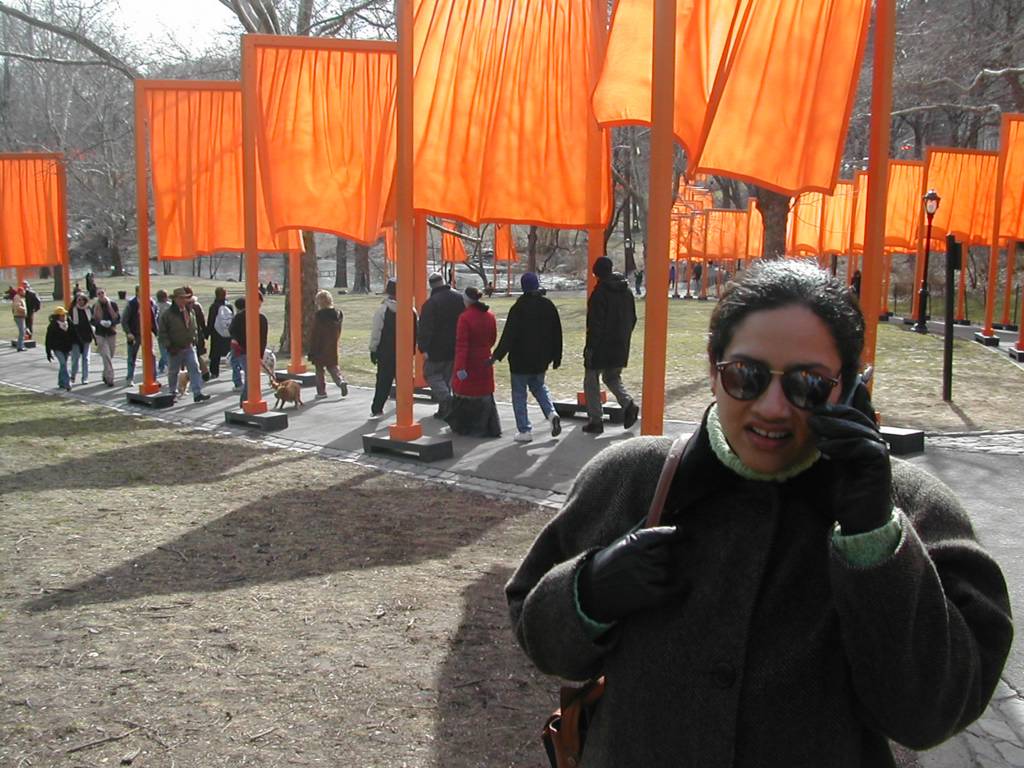
The resolution is fairly low here, but clearly the US Capitol grounds and some nearby bldgs are blurred. It is not as if it is hard to find nor unknown how it looks, so why the cloak and dagger?


Hi Ann, Regarding explanations for why personal accounts will help the long-term solvency of Social Security: For the past few years, I have been thinking about the Social Security Trust Fund and reading about it, but have never heard a take on it like the one I have. I know, I know! Now comes the bizarre fringy ‘take’ on it. The Trust Fund is supposedly for the purpose of making up funds needed for beneficiaries once outlays begin to exceed the money coming into the system. (This is expected to begin in about 9 years) The problem is that the trust fund doesn’t contain any assets, only obligations. Personal accounts divert money from the trust fund; but for each dollar diverted, a dollar of future liability is removed. This will not help the overall financial situation if nothing else changes because, each dollar diverted from the trust fund will be added to the deficit. Currently, the federal deficit is calculated by subtracting the surplus of Social Security funds from the actual deficit, thus hiding the true state of deficit spending. It is hoped that by ‘unmasking’ the true deficit, this will cause downward pressure on government spending. If the government can reduce its debt load, then the future ability to add debt will be increased. I hope this is a clear answer. I am not a politician, so I at least try to write clearly! Best regards, DavidNote: I did some editing on the letter to Prof Althouse in Hotmail, so what I sent her is a bit different from what is presented here.
Mrs. Schiavo has been in what is called "A Persistent Vegetative State" for more than a decade following a heart attack. Her husband Michael has been spending much of that time trying through legal means to have her feeding tube removed, so that she will die of dehydration. Mr. Schiavo's main opponent in his legal quest has been the family of Mrs. Schiavo. Mr. Schiavo, while still married to Terri, has in the past several years been living with another woman. This unmarried pair has produced a couple of children and will surely benefit from the life insurance which will come to them once Terri Schiavo dies.Most marriage vows include something to the effect that one must remain faithful through sickness or health until separated by death. Of course divorce law in every state does allow a marriage to be dissolved for any (or no) reason, so Michael could have divorced his wife long ago. Terri's parents have made it clear that they would be happy to take responsibility for her care, so he could leave the marriage with a fairly clean conscience. In any case, Michael's obvious lack of faithfulness indicates that he has in fact moved on with his life. He, like many who have an ethical challenge put before them, has been found wanting: He would like to keep the power of life and death over his wife while in any but the legal sense he has long ago left his marriage. Let Her Die ? The thing which caught my interest in the newscast was when the news reader spoke of a legal victory by Michael Schiavo as having the result the Terri Schiavo would be allowed to die. There are those who argue that all language contains bias, maybe so, maybe so, but surely it is possible for there to be degrees of bias. For instance, I think a simple recitation of the facts would be fairly neutral: Here is my attempt: If Michael Schiavo wins his legal case, the result will be that the feeding tube which keeps Terri Schiavo fed and hydrated will be removed and she will die. What are the assumptions being made by the NPR reporter? When the word "allow" is used in a case like this, what it normally means is that a course of action desired by some actor will not be prevented. So the assumption here is that Terri Schiavo wants to die. She in fact has no choice: She will continue to live if she is fed and she will surely die if she is not fed. A second meaning of allow does not rely on desire, but is more like what we think of as nature. For instance, if I pull the drain plug out of a sink, this will allow water to run down the drain. In this sense, the NPR reporter is on firmer ground—there is nothing natural about a feeding tube, nor most of medical care for that matter. However, starving a baby or invalid who cannot feed them selves is not okay and would usually result in charges being filed. Most people think of machines which perform some physical function when they say things like "I don't want to be kept alive by a machine" etc. So, even here the ground gives way for our NPR reporter. I think it is safe to say that our NPR reporter has given away who's side he is on in this legal case as have I. dbp Update: An excelent view... Whose life is it to end? By George P. Bush Read it all...
American society is about to enter dangerous territory, in which the slow-motion killing of a woman by her faithless husband will have been sanctioned by the court. After Terri's death, where will we draw the line between one's right to privacy and another's right to life? Are our legislatures to have no say in the matter? It is inconvenient to Michael Schiavo and to the Florida courts that Terri Schiavo continues to live and that her parents won't relent and let her die of thirst and starvation. If Mr. Schiavo prevails, then every person whose life is considered of negligible quality by a court or a legal guardian could be condemned. There is more at stake here than the fate of one solitary woman. After this Friday, it becomes possible that, in this country, if the unwanted and the weak are simply too burdensome to us as individuals, that the right to rid ourselves of inconvenient lives will be our courts' guiding principle.
Here is a further update from The Corner where the coverage has been constant.
The time of year for this to be happening is too coincidental for my taste. A novelist would have Terri die on Friday the 25th (Good Friday) and have her spirit appear to her husband, or perhaps to all of us on Easter Sunday. Will she settle the issue and tell us if we did good or evil? Maybe she will just smile down upon us, reproachfully.
dbp
AS WE PASS 100 HOURS OF STARVATION AND DEHYDRATION ... [Andy McCarthy]
...something that wouldn't be done to an animal and couldn't be done to the worst convicted murderer." But then it actually happens ... slowly. You're powerless to stop it, and ... you find your life goes on.
There are kids and jobs and triumphs and tragedies and everyday just-getting-by. An atrocity becomes yet another awful thing going on in the world. After a day, or maybe two, of initial flabbergast, we're talking again about social security reform, China, North Korea, Hezbollah, etc. A woman's snail-like, gradual torture goes from savagery to just one of those sad facts of life.
As is the case with other depravities once believed unthinkable, it coarsens us. We slowly, and however reluctantly, accept it. We accept it. The New York Times no doubt soon "progresses" from something like "terminating life by starvation," to "the dignity of death by starvation," to "the medical procedure that opponents refer to as starvation." And so the culture of life slides a little more. The culture of death gains a firmer foothold.
Of course, the physical needs of the body are not limited to food and water. There is also air. But no judge, even in Florida, would ever have had the nerve in Terri's case to permit "the medical procedure that opponents refer to as asphyxiation." Too crude. Too quick. Too obviously murder of a vulnerable innocent. Brazen, instant savagery might wake us from our slumber. For the culture of death, better that we sleep. Posted at 10:47 PM
A SOLDIER convicted in connection with the Iraqi abuse court martial was described at the trial yesterday as "a bit of a nutter" who loved violence so much that he was ordered to undergo psychiatric counseling.I have heard of no abuses at Guantanimo Bay, but have full faith that if crimes come to light they will be similarly pursued. Now let us compare the case of Iran with a couple of cases: First, the case of Atefeh Rajabi who was acting about like an average American teen. as described by the Women's Freedom Forum
A 16 year old girl hanged in public in the city center of Neka, North of Tehran. The teenage victim had no access to a lawyer at any stage. In court, she told the religious judge that he should punish those who force women into adultery, not the victimsSecond, the case of Kaveh Habibi-Nejad from Indymedia
Both of these outrages are typical in Iran. Also typical is that they were done by the authorities. The perpetrators of these acts are not considered criminals by the government of Iran, they are in fact part of the government of Iran. What kind of moral idiot compares the criminals of one country with the officials of another and looks for equivalence between the two? The BBC's Frances Harrison, for one. Who Else? I don't think it would be hard to find more. dbp14-year-old boy ‘flogged to death’ in Iran
Iran Focus News 26 Nov 2004 00:22 GMT14-year-old boy ‘flogged to death’ in Iran: Thursday 25 Nov 2004 Tehran - New information has come to light over the sudden death of a 14-year-old schoolboy in western Iran, who died after being flogged for “eating in public” during the holy Islamic month of Ramadan. Kaveh Habibi-Nejad died Nov. 12 and was buried in the cemetery of the Kurdish city of Sanadaj on Nov. 13, according to his death certificate.Another child allowed to be 'punished' to death.

 Posts
All Comments
Posts
All Comments